
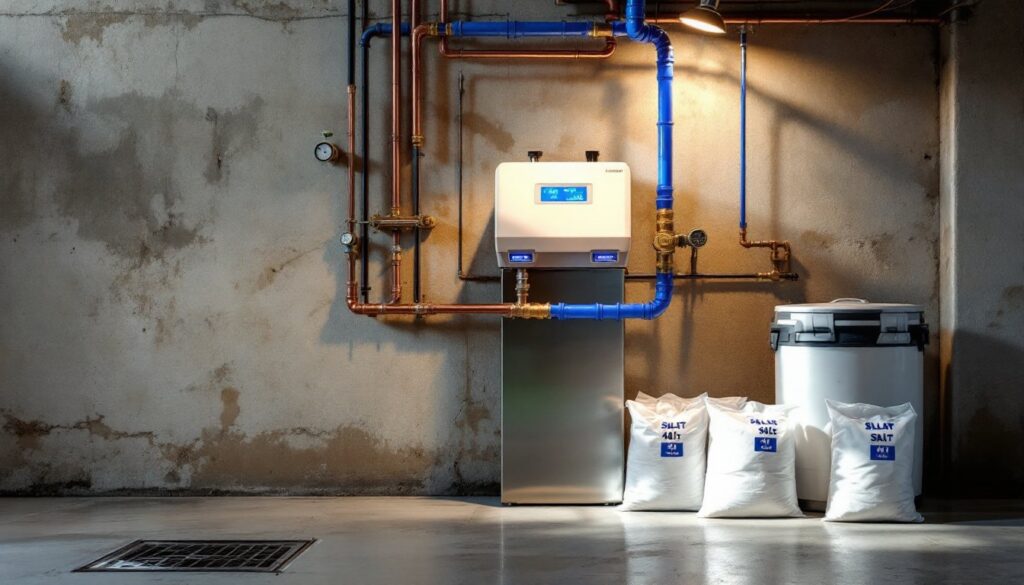
If your shower leaves your skin feeling tight, your dishes spot-stained, and your pipes potentially clogged, you’re dealing with hard water, and you’re not alone. About 85% of American homes have hard water issues. A water softener can solve this, but before calling a plumber, the big question is: what’s the real cost? Water softener pricing ranges from $500 to $5,000+ for the unit alone, plus installation labor that can run $200 to $1,500 depending on your setup. Understanding what factors into that total price helps you make a smart investment, not an impulse buy that leaves you regretting the plumbing bill.
Table of Contents
ToggleKey Takeaways
- Water softener costs typically range from $700 to $7,000+ total, with most homeowners investing $1,500–$3,500 all-in for unit and professional installation.
- System type and grain capacity are the primary factors affecting water softener pricing—budget models cost $500–$1,200, while mid-range systems run $1,200–$2,500 and premium options exceed $2,500.
- Installation labor varies from $200–$1,500 depending on plumbing accessibility and complexity, so always get itemized quotes from multiple plumbers before committing.
- Beyond the initial purchase, plan for ongoing costs including salt refills ($300–$600 yearly), water testing ($100–$300), and optional maintenance plans ($200–$400 annually).
- A quality mid-range water softener typically pays for itself within 5–8 years through appliance longevity and reduced maintenance costs, making it a worthwhile investment for homeowners with documented hard water above 7 GPG hardness.
Understanding Water Softener Pricing Factors
Water softener costs hinge on several variables: system type, grain capacity, and features. A grain capacity rating tells you how many grains of hardness a softener can remove before needing regeneration. Smaller homes with 2–3 people might use a 20,000-grain system ($500–$1,200), while a family of five typically needs 32,000 to 48,000 grains ($1,200–$2,500).
There are three main types. Salt-based ion exchange systems are the most affordable and effective ($500–$2,500) but require regular salt refills and drain discharge. Potassium chloride alternatives cost 10–20% more but are better for septic systems. Magnetic or electronic descalers run $300–$800 but are less proven and typically work better as supplements than standalone solutions.
Brand reputation matters. A generic 40,000-grain softener from an off-brand might cost $800, while the same capacity from Culligan or Water-Right runs $1,500–$2,000. That premium reflects warranty length (often 5–10 years), customer support, and reliability data. Don’t automatically chase the cheapest option, a $600 unit that fails in three years costs more than a $1,400 system lasting 10 years.
Installation Costs and Labor Expenses
Labor is where surprises happen. A straightforward DIY-friendly installation in a finished basement with existing plumbing might run $200–$400 with a handy person. Most homeowners, though, should budget $500–$1,500 for professional installation.
Why the wide range? Accessibility matters. If your water main is easy to reach and your plumbing setup is standard, you’re looking at the lower end. If the plumber needs to break concrete, reroute copper lines, or run new ¾-inch PVC across the house, costs spike. Installing a bypass valve, sediment filter, or pressure gauge, smart preventive additions, adds $100–$300 each.
According to industry data, plumbers typically charge $75–$150 per hour, so a two-hour install (realistic for straightforward work) runs $150–$300 in labor alone. A complicated install with multiple fixtures or water heater rerouting can take 4–6 hours. Always ask for a detailed estimate before committing. Some local plumbing codes require a permit (another $50–$150), so confirm that upfront rather than discovering it after purchase.
Budget, Mid-Range, and Premium System Comparisons
Budget systems ($500–$1,200 unit + $200–$500 labor): These are compact, single-tank salt-based softeners with 20,000–32,000 grain capacity. They’re fine for smaller homes or renters, but they regenerate frequently (sometimes nightly), using more salt and water. Warranty is typically 3–5 years. Maintenance is your responsibility, salt refills every 1–2 months, basic troubleshooting.
Mid-range systems ($1,200–$2,500 unit + $500–$1,000 labor): This is where most homeowners land. Dual-tank or demand-initiated regeneration models reduce waste and salt usage. Grain capacities hit 40,000–48,000, covering families of 4–6. Warranties extend to 7–10 years. Many include basic service plans or discounted salt delivery. Total project cost lands around $2,000–$3,500.
Premium systems ($2,500–$5,000+ unit + $1,000–$1,500 labor): High-end brands like Culligan or Kinetico offer smart-home integration, app monitoring, and salt-free options. Some feature hybrid systems combining ion exchange with magnetic conditioning. Warranties often cover parts and labor for 10 years. These make sense if you have severe hard water (>20 GPG grains per gallon), large families, or want minimal maintenance. Total outlay: $4,000–$7,000+.
For a real-world comparison: a 40,000-grain mid-range system totaling $2,200 might handle a family of four for 15–20 years with proper maintenance, while a $800 budget model might need replacement or major repair in 8 years. The ROI isn’t always obvious upfront.
Additional Costs to Consider Beyond the Unit
The softener price tag doesn’t tell the whole story. Salt or potassium chloride refills cost $50–$100 per 40-pound bag, used every 1–2 months on average. That’s roughly $300–$600 yearly. If you switch to potassium chloride (better for septic systems), add 20–30% to that number.
Water testing ($100–$300) is essential before and after installation to confirm hardness levels and softener effectiveness. Many plumbers include basic testing, but comprehensive analysis (iron content, pH, TDS) costs extra.
Drain and electrical setup may require modifications. Most systems discharge to a basement floor drain or laundry sink, but if you need a dedicated line installed, that’s another $200–$500. Softeners drawing electricity for controls or backlit displays need a dedicated outlet nearby, a licensed electrician can add one for $150–$300.
Annual maintenance and service plans range from free (DIY) to $200–$400 yearly through brands offering filter changes, resin replacement, or emergency repairs. Some homeowners skip these and handle salt refills solo, paying only when something breaks.
Warranty and service contracts vary wildly. A $1,500 unit with a 3-year parts-only warranty differs drastically from one offering 10 years full coverage. Read the fine print.
How to Save Money on Water Softener Installation
Get multiple quotes. Call three to five local plumbers and ask for itemized estimates. Prices vary by $500+ for identical work. Make sure each quote includes the unit, labor, permits, bypass valves, and any modifications specific to your setup.
Buy the unit separately. Some plumbers markup equipment heavily. Research models online, then ask plumbers for labor-only pricing on your chosen system. This can save 15–25% compared to letting them select and mark up.
Perform basic prep work yourself. If your install is straightforward and your plumber agrees, clear the area, shut off the water main ahead of time, and empty that basement floor drain. An hour of prep work you do saves the plumber time, and you money.
Combine projects. If you’re already having plumbing work done (repiping, water heater replacement), bundle the softener install and negotiate a package rate. Contractors often discount bundled jobs.
Explore DIY installation. For straightforward setups (tank in basement, single bathroom feed), a handy person can install a softener using YouTube guides and the manufacturer’s manual. You’ll handle materials and bypass valve installation, saving $300–$800 in labor. But, be honest about your skill level, a leaky fitting costs far more than the labor you tried to save.
Ask about seasonal discounts or sales. Some water softener dealers run promotions in off-season months (winter in cold climates). Timing your purchase can yield 10–15% savings.
Is a Water Softener Worth the Investment?
Hard water damages appliances, reduces soap and shampoo effectiveness, and strains plumbing. Over 10–15 years, a softener paying $300–$400 yearly can preserve thousands in water heater, washing machine, and dishwasher repairs. Industry studies show soft water extends appliance life by 20–40%.
You’ll also notice quality-of-life improvements: softer skin, shinier hair, spot-free dishes, and cleaner shower doors. These aren’t quantifiable in dollars but matter daily.
That said, a softener makes the most sense if your water tests above 7 GPG hardness. Lower levels might not justify the cost. Renters should explore portable or renter-friendly compact systems ($300–$600) instead of permanent installation. Homeowners with severe hard water and large households nearly always break even within 5–8 years through appliance savings and reduced cleaning product costs.
Before committing, test your water (most plumbers do this free or cheap). Then weigh the long-term savings against upfront cost and ongoing maintenance. If you’re staying put for 10+ years and hardness is documented, a quality mid-range softener is a smart investment.
Conclusion
Water softener costs in 2026 range from $700 total for a budget DIY install to $7,000+ for premium systems with full professional setup. Most homeowners spend $1,500–$3,500 all-in. The real value lies in matching the system to your water hardness, home size, and lifestyle, then choosing a reputable brand with solid warranty backing. Get multiple quotes, understand your water chemistry, and don’t skip the professional testing. A softer system may cost more upfront, but it pays dividends in appliance longevity and daily comfort.